
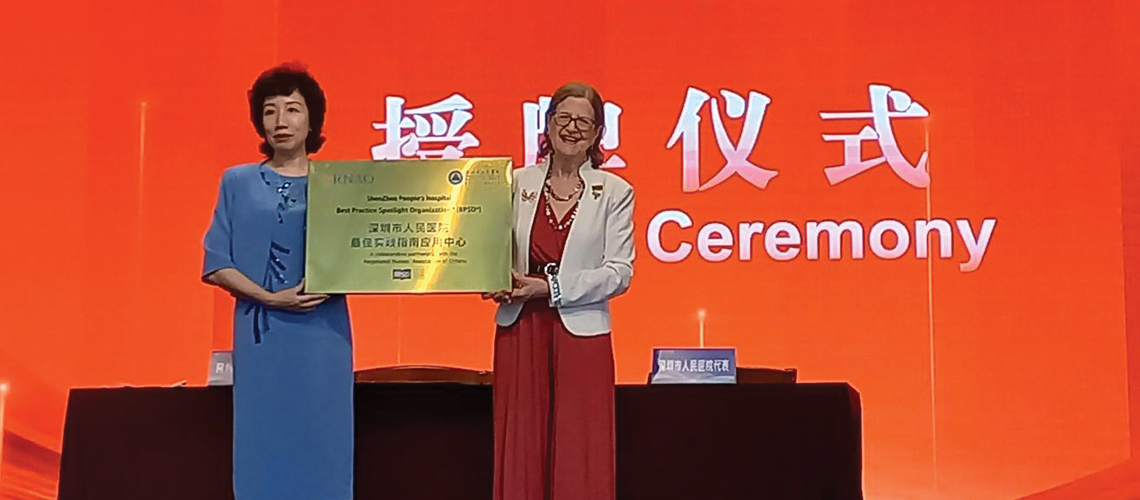
As the importance of RNAO’s Best Practice Spotlight Organization® (BPSO®) Program continues to captivate leaders worldwide – and more and more countries join the movement – RNAO is expanding its Host model initiative, first introduced a decade ago in Ibero-America.
Spain, Chile and Colombia (members* of the Ibero-American consortium) were the first countries to realize, alongside Dr. Doris Grinspun, RNAO CEO and founder of the Best Practice Guidelines (BPG) and BPSO programs, the necessity for countries seeing an explosion of interest to lead and manage their own expansion. Under the Host model, each country – with the guidance and oversight of an RNAO master coach (in this case Grinspun) – began to move from BPSOs being trained, mentored and reporting to RNAO to a BPSO Host in their own country taking on these functions.
The BPSO Host model includes a tiered structure that builds capacity within countries. This includes the development of national hosts for both service and academic sectors, supported by regional host organizations with BPSO leads who can provide local training, mentorship and oversight.
“The appetite for the program is immense, and we’ve reached a point where more BPSO Host countries will benefit from leading their own growth,” Grinspun says. “This is an example of what I’ve been calling “purposeful evolution” since publishing our book about the evolution of the BPG program (Transforming Nursing Through Knowledge) in 2018.”
Janet Chee, RNAO's associate director of guideline implementation and knowledge transfer, says she is relieved and excited. Overseeing the growth of BPSOs to more than 1,500 worldwide (900 in Ontario alone) is both important and complex, she says. Chee is now working with China’s BPSOs to launch their national Host model, building on lessons-learned from the Ibero-American consortium.
“The vision is to support long-term growth through collaboration with organizations that have been part of the BPSO program for nearly a decade and have extensive experience implementing guidelines. These partners are prepared and eager to take on the role of host to guide newer organizations to support the spread of BPGs across regions,” Chee says.
The BPSO national and regional model is expected to guide most international expansion going forward, allowing for faster growth and fidelity to RNAO’s BPSO methodology. “We are cementing a structure that supports both scale and sustainability,” Chee says. “It’s about ensuring that as the program grows, it continues to deliver high-quality, evidence-based care using RNAO’s guidelines and the implementation rigour of the BPSO model.”
National expansion of long-term care pathways
RNAO’s Clinical Pathways for Long-Term Care (LTC) initiative is expanding outside of Ontario, with homes in Manitoba and British Columbia already participating, and growing interest from partners in Alberta. The expansion has been driven by interest in strengthening consistency in care across the country. Manitoba and British Columbia are in the early implementation phase, working with RNAO to adapt the pathways to their local contexts.
Clinical Pathways embed RNAO BPGs directly into electronic medical records, transforming how evidence is implemented and sustained in LTC settings. There are 257 Ontario homes participating in the program. Developed in partnership with PointClickCare and co-designed with subject matter experts, the pathways support clinical decision-making, care planning and documentation in real time.
“What this approach allows us to do is scale implementation in a way that is consistent across organizations,” says Rita Wilson, senior program manager at RNAO. “It helps ensure that best practices are applied more reliably across settings, not just introduced.” She notes that embedding guidelines into digital systems significantly accelerates the translation of evidence into practice and improves the measurement of outcomes.
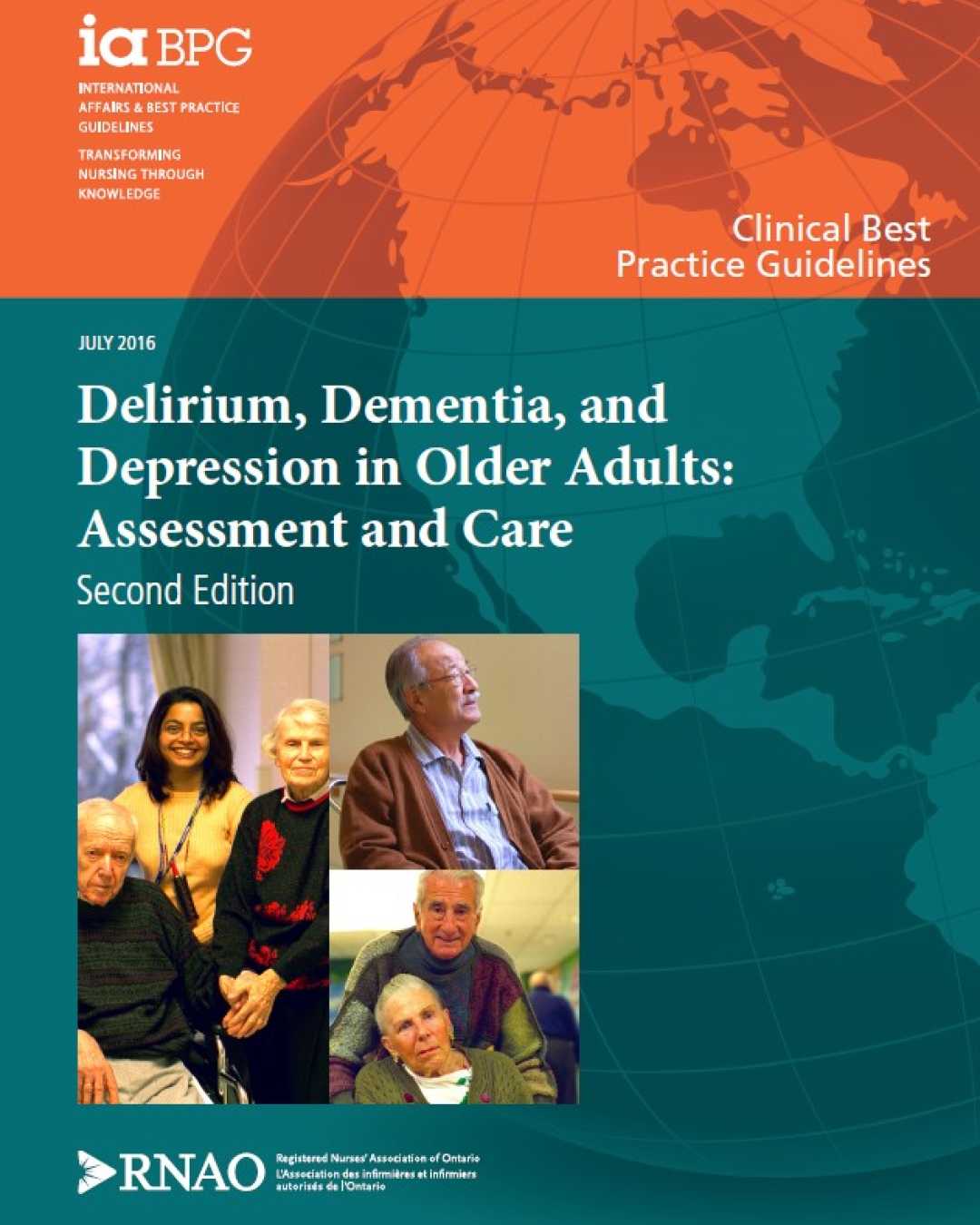
RNAO’s Delirium, Dementia and Depression in Older Adults: Assessment and Care BPG, for example, recommends screening older adults upon admission. With the introduction of a clinical pathway, screening is now a regular part of admission processes across participating homes. “It’s not just about introducing best practices. It’s about building them into everyday workflows,” program manager Brittany Young says.
As the initiative continues to grow in Ontario and across Canada, it will continue to allow for local adaptation.
Measuring BPG impact in academic settings
For more than two decades, BPSOs have used clinical indicators to measure the impact of BPGs. These indicators enable organizations to monitor progress, track practice changes and evaluate whether implementation leads to improved people’s care, organizational and health-system outcomes.
When RNAO began integrating BPGs into nursing education, it became clear that measuring success in academic environments would require a different approach. “While clinical indicators can show if implementation leads to fewer falls or pressure injuries, the question in education is whether students are learning to apply evidence-based practice – and will they carry that knowledge into their future practice,” says Dr. Amalia Silva, professor at the Universidad de Chile and a key leader in advancing academic BPSO initiatives in Chile and Portugal (pictured below, second row, left).
Silva is also a member of RNAO’s groundbreaking collaboration – known as the Academic BPSO Consortium – that has brought together the leads of 15 international academic BPSOs to work with RNAO staff to design indicators tailored specifically to nursing education.
These 21 structure, process and outcome indicators, which were finalized in February 2026, “…capture how BPGs are integrated into nursing education, ensuring that evidence-based practices are embedded throughout curriculum design, teaching strategies and student learning experiences,” says Dr. Shanoja Naik, RNAO’s Research Unit director. They examine faculty and student capacity, BPG-informed teaching, experiential learning opportunities, and the development of leadership and guideline champions.
Preparing nurses to think and act through an evidence-based lens is essential to advancing quality care and improving health outcomes across health systems.
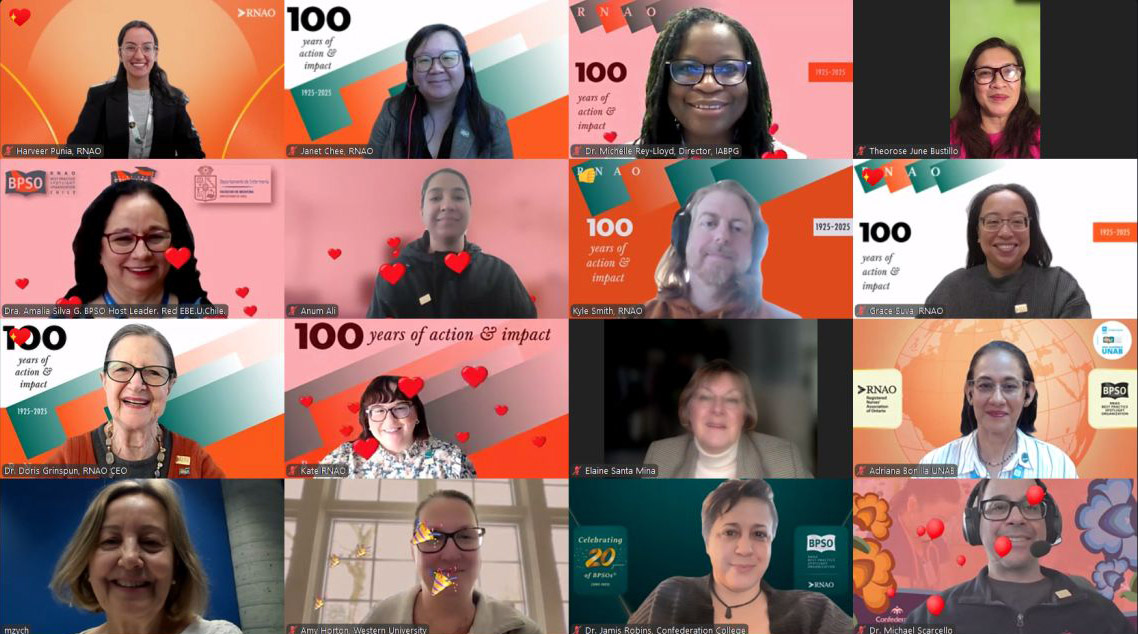
“The next phase requires academic BPSOs to actively generate meaningful evidence by collecting survey data from both students and faculty,” says Harveer Punia, RNAO’s senior implementation science manager and lead for academic BPSOs (pictured above, first row, left).
Building on RNAO’s already robust data infrastructure, the indicators have been integrated into the Nursing Quality Indicators for Reporting and Evaluation® (NQuIRE®) system, allowing academic BPSOs to systematically collect and analyze data. This will strengthen their ability to monitor outcomes and generate real-world evidence on the impact of BPGs.
Unlike clinical indicators – which can often be linked to outcomes quickly – the impact of academic indicators will take longer to fully understand. Adriana Bonilla Marciales (above, third row, right) and Olga Lucía Gómez Díaz (not pictured), academic BPSO hosts in Colombia and leaders in the indicator development work of RNAO, emphasize that understanding whether students translate what they learn into practice may require years of follow-up. This longer timeline is essential to ensuring sustainability in clinical settings and diverse communities with varied needs.
For Grinspun (above, third row, left), this initiative reflects a long-standing vision and commitment to close the gap between education and practice. “Preparing nurses to think and act through an evidence-based lens is essential to advancing quality care and improving health outcomes across health systems,” she says. “As I wrote in my column, the future of nursing education is not waiting to be written. We are writing it – together.”