

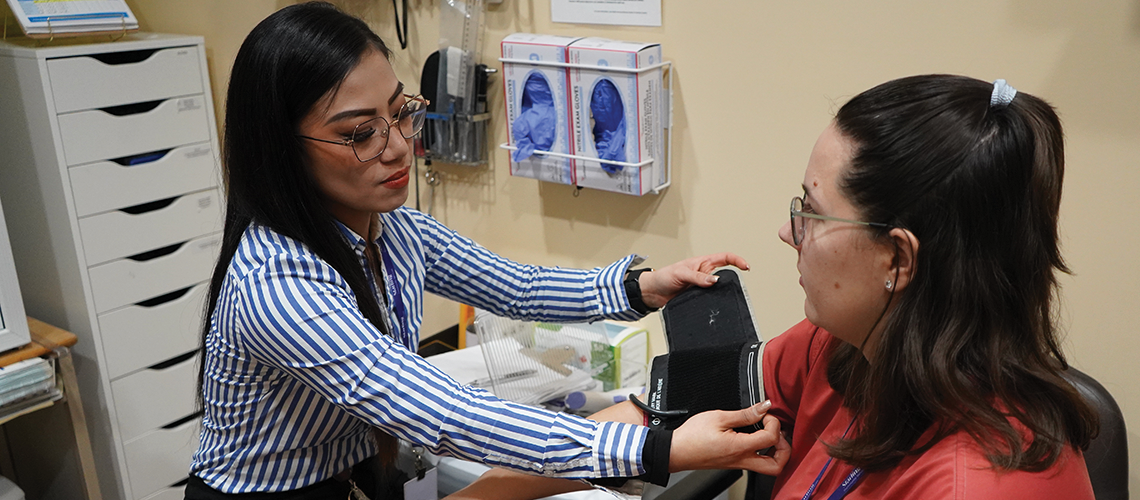
When RN Ruby Amoncio assessed an infected wound on her 16-year-old patient, she knew it was an important issue that needed to be addressed promptly. The wound was urgent for a teenager who was already navigating complex mental health challenges.
After completing her assessment, Amoncio reviewed the patient’s history, consulted her clinical decision tools and prescribed a topical antibiotic. In just 30-45 minutes, the patient was on their way home from Starling Community Services, a not-for-profit organization in Waterloo Region and Wellington County that provides accredited children’s mental health services, as well as employment and housing supports. The interaction was fairly straightforward, but it would have been far more complicated two years ago.
In the past, Amoncio would have sent the patient to a walk-in clinic to wait in a room of strangers just to receive the required prescription. “Can you imagine being a teenager with anxiety, depression…and now you’re sitting in a crowded waiting room?” says Amoncio. “Some of (my patients) have significant trauma and a lot of distrust of strangers and adults.”
With the announcement of RN prescribing in 2023, that scary reality changed, and a whole new level of nursing care was introduced.
In a family health team setting, being able to prescribe means our appointments are more comprehensive.
As an RN prescriber, Amoncio can now assess, determine appropriate treatment and prescribe within her authorized scope without any unnecessary delays or added barriers. “Most of our clients come from families that are still navigating this very complex (health) system,” she says. By removing the extra trip and related costs (e.g. gas, transit), Amoncio is supporting patients already struggling with mental health challenges and ensuring they receive timely care.
RN prescriber Stephanie Daye, who works at Kingston Family Health Team (KFHT), couldn’t agree more.
Daye has supported numerous clients in need of primary care, including new mothers experiencing breastfeeding difficulties and infants with diaper rash. “In a family health team setting, being able to prescribe means our appointments are more comprehensive,” she says. “We can address everything in one visit rather than asking patients to come back for an issue we’ve already identified.”
As experienced RN prescribers, Daye and Amoncio shared their insights during a December 2025 webinar hosted by RNAO. They discussed the real-world impact of this expansion in nursing practice, along with some of the realities that come with pursuing this path. They also touched on the important role RN prescribers play in embedding the expanded scope into their workplaces. In addition to completing the essential education, Amoncio and Daye had to navigate organizational approval processes.
RNJ ACCESS
You are only one quick step away from full access to all RNJ content.
Already an RNAO member? Log in
RN prescribing
It is so energizing and inspiring to see Nurses continue to expand their scope of practice to support patients' access to timely and high-quality care. Bravo to RNAO, CNO, Legislators and Education sector leaders for collaborating so effectively on this groundbreaking initiative!