Conversations about death a must
RN and palliative pain and symptom management consultant Kim Rogers helped to make end-of-life a little easier to talk about thanks to an annual education series called Completing Life’s Journey in the Haldimand Norfolk Community. Celebrating its second year, the education series, which was organized by Rogers in partnership with other health professionals, covered topics such as hospice palliative care, medical assistance in dying (MAID), and the legal aspects of health care. The series took place throughout September and October. “(As a society)…palliative care is something we don’t talk about. It’s something that we need to talk about; whether for ourselves (or) our family,” Rogers says. “It’s something that will eventually affect everyone.” One of the challenges, however, is the lack of palliative care in certain areas of the province. “The availability of palliative care depends very strongly on where you live,” explains Rogers. A lot of people do not know what resources are out there. She hopes the annual education series will allow more people to become aware of what’s available to them in the community. To find out more, visit seniorsupport.ca (The Sachem, Aug. 30)
Hallway health care still a problem
In response to the Ontario government’s announcement in October to spend $90-million this year to fund hospital beds ahead of flu season, RNAO President Angela Cooper Brathwaite spoke to CBC News about how the move does little to solve hallway health care. “Beds don’t take care of patients. They need health-care professionals. They need more nurses,” Brathwaite says, adding that Ontario has the fewest RNs per population compared to the rest of the country. Ontario Premier Doug Ford and Health Minister Christine Elliott announced the government will fund 1,100 beds, 640 of which are new and will add surge capacity during flu season. However, RNAO says the government should be focusing on funding permanent, full-time RNs to ensure the continuity of care patients need and deserve. RNAO is also urging the province not just to focus on hallway health care, but also on the importance of primary care and home care to promote health and prevent disease. (CBC News, Oct. 3)
Government moves forward with SIS and OPS sites
RNAO is praising the province’s announcement in October to move ahead with supervised injection services (SIS) and overdose prevention services (OPS), suggesting it is a step in the right direction. “This day is absolutely a day for celebration for people with addictions and opioid substance use and for their families,” says Doris Grinspun, RNAO CEO. Included in the government’s announcement was the introduction of a new model and a rebranding of SIS and OPS as ‘consumption and treatment services.’ “These clinics will be better linked to other services, including rehabilitation services for those who are ready to engage with rehabilitation,” Grinspun says. Noting that not everyone is ready to engage, she adds that there will be no obligation to sign an agreement to rehabilitate to access the overdose consumption sites. According to Health Minister Christine Elliott, there are currently 16 sites in operation across Ontario, with three more waiting to start providing services in Thunder Bay, St. Catharines and Toronto. (London Live with Mike Stubbs, Oct. 22)
Chatham nursing students raise awareness, funds for homeless
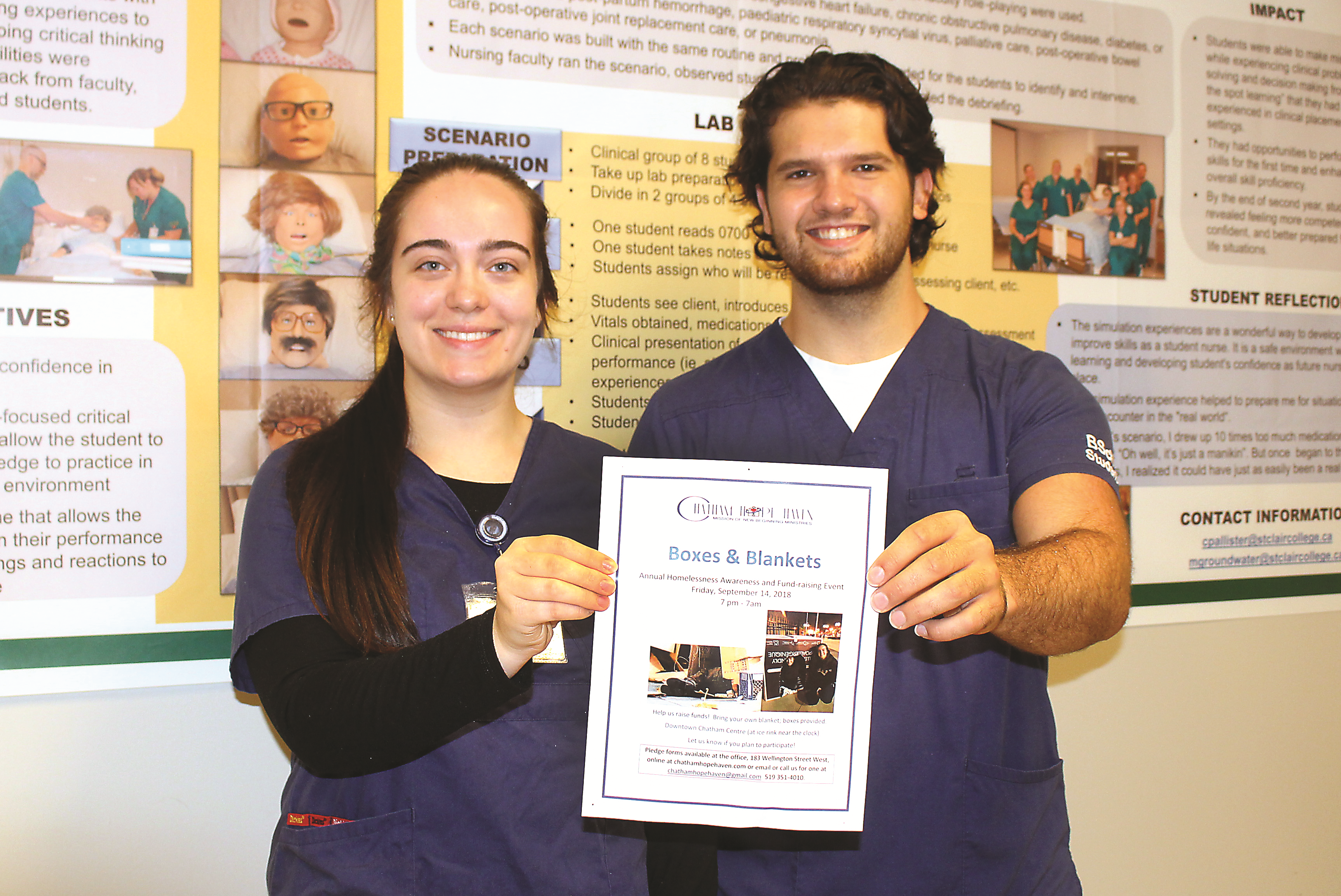
With only blankets for warmth and boxes for shelter, nursing students Stephanie Williams and Derion Ducedre slept on the streets of downtown Chatham in September to raise funds and awareness about homelessness. As part of the fundraiser, Boxes & Blankets, Williams and Ducedre helped recruit other students to participate and raise money for the local men’s shelter, Chatham Hope Haven. Spending time on the street and “…seeing what they actually have to deal with, the rain and different weather conditions, and how cold it can be…” is different from learning about the challenges in a classroom, says Williams. Through the experience, participants were able to speak with some of the men who use the shelter and learn more about their stories. “It seems to be a continuing and growing problem, especially in southwestern Ontario,” Ducedre says. It is important to combat the stigma and misconception that all homeless people have a drug or alcohol problem, he adds. The fundraising efforts amounted to $4,800 for the shelter. (Chatham Daily News, Sept. 10)
Coroner’s jury releases recommendations
A jury examining the circumstances surrounding the death of Grant Faulkner made sweeping recommendations June 20 that RNAO hopes will lead to better support and housing services for homeless people. The 49-year-old Toronto man died after a makeshift shelter he had fashioned out of plywood caught fire on a bitterly cold January night in 2015 in an industrial part of the city’s east end.
RNAO was among those to call for a coroner’s inquest, and provided recommendations for the jury to consider. The jury’s final recommendations included:
- increase social assistance provided to individuals so it reflects the real cost of shelter and basic needs
- ensure alcohol treatment and rehabilitation programs are available, and take into account the needs of people who are homeless
- allow city outreach staff to provide survival equipment and supplies, such as fire retardant blankets, safe heating sources, and sleeping bags
- consider zoning changes that might increase the availability of housing, such as rooming houses, laneway housing, etc.
- continue to participate in the National Home Strategy
RNAO was pleased that the jury also recommended honouring Grant Faulkner’s memory by establishing a permanent memorial in Scarborough. Such a move, the jury argued, was necessary “…to provide the important ongoing public safety message that the protection of the homeless in Ontario is every citizen’s responsibility.”
See RNAO’s response and link to the full list of recommendations at RNAO.ca/FaulknerInquest
Hand’s off Ontario’s sex-education curriculum
More than 2,500 people have responded to RNAO’s action alert calling on the government to keep in place the modernized health and physical education curriculum (sex-ed curriculum). It has been taught since 2015 and includes information on consent, sexual orientation, gender identity, the dangers of cyber-bullying, online predators and sexting. The previous sex-ed curriculum dates back to 1998, before the Internet and smart phones were widely available.
RNAO argues the 2015 curriculum is critical to the health and wellbeing of children, and provides them with the information and skills needed to protect themselves and those around them from abuse, sexual assault and bullying. And, with just days to go before school begins, it makes no sense for Premier Ford to revert to the 1998 curriculum while his government consults with parents in all 124 provincial ridings. Sign RNAO’s action alert at RNAO.ca/sexEdAA
PPE council member gets key to city of Toronto
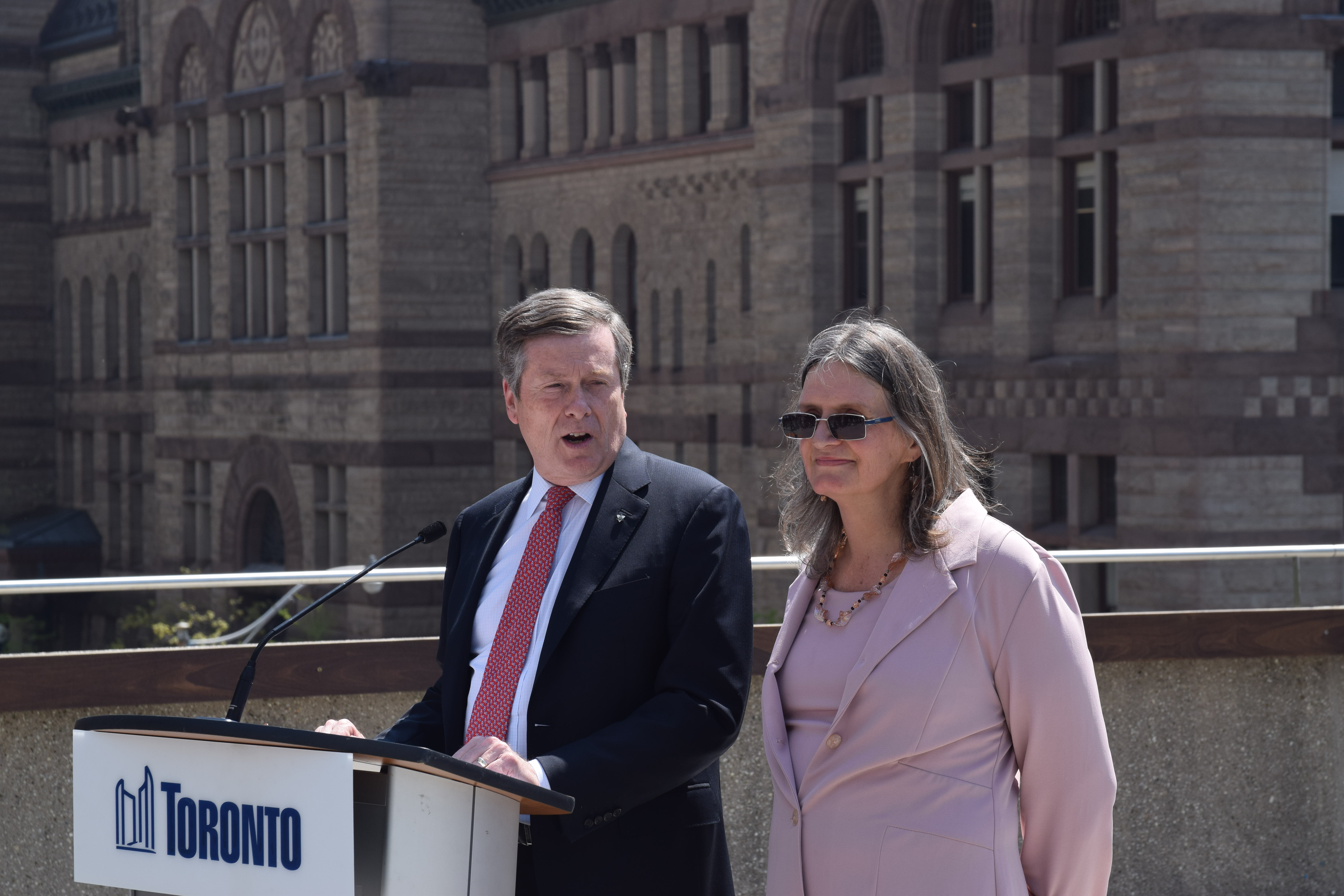
Susan Gapka, a trans rights activist and member of RNAO’s Patient and Public Engagement (PPE) council, received one of seven keys to the city from Toronto Mayor John Tory on May 17. She is the first transgender person to receive this honour. Gapka came to Toronto as a teenager and spent 10 years living on the street. She volunteered for Parkdale Community Health Centre’s street outreach program 30 years ago while homeless, and became a member of its board of directors 10 years later, after finding housing. In this role, she helped create the first community based methadone clinic in Ontario. She founded the Trans Lobby Group, which lobbied for public funding for transition-related surgeries, as well as amending the Ontario Human Rights Code to include ‘gender identity’ and ‘gender expression.’
“This, hopefully, is a metaphor that we can use this key to provide opportunities to those who lack access to a decent home, good health care, transportation, or food,” Gapka says. “I’m hopeful that this may help achieve some of that.”
RNAO was on-hand May 17 to celebrate Gapka’s recognition from the city. As a member of the association’s PPE council, RNAO looks to Gapka and others for insight on patient, family caregiver, and public engagement. This insight informs the organization’s overall goals, including its healthy public policy work. The council is comprised of members of the public as well as health-care providers. Its goal is to focus on the patient lens of health care to help shape RNAO’s values.
RNAO calls for updated sex-ed curriculum to stay
Premier Doug Ford announced in July that Ontario students will be taught the province’s 20-year-old sexual education curriculum in the coming school year. RNAO president Angela Cooper Brathwaite says the decision may put children at risk. “It is irresponsible to do away with the current version and revert to a 20-year-old sexual education curriculum that doesn’t address today’s realities of the Internet, smartphones and social media,” says Brathwaite.
“If children are going to be safe and healthy, they need to learn about consent, sexual orientation, gender identity, as well as the dangers of cyberbullying, online predators and sexting.” In response to the premier’s announcement, deputy premier Christine Elliott says the government is acting upon the wishes of parents for more consultation, noting the government was concerned about the age that children were being taught about certain subjects. “We want to conduct a full public consultation with parents to make sure that we understand what parents are comfortable with having their children learning in schools,” says Elliott. (Toronto Star, July 19)
Nurses call for continued SIS
Following an August announcement that the provincial government will review the evidence on supervised injection services (SIS) and overdose prevention sites to see if they are worth continuing, Ontario nurses are concerned the move is a step in the wrong direction. “It’s disappointing and heartbreaking because there is a huge body of evidence (that points to its efficacy), and lives are literally in the balance,” says Lynn Anne Mulrooney, RNAO senior policy analyst. At Insite, Vancouver’s supervised injection facility, there have been more than 3.6 million visits since its inception in 2003, and more than 6,400 overdoses have been reversed by staff. Mulrooney adds that no one has ever died at the facility. “In a better world, nobody would be in this situation, but in the meantime, we’re in an emergency, so we have to respond appropriately.” (Bill Kelly Show, Global News, Aug. 8)
Letter to the editor: Private drug insurance vs. government pharmacare program
In response to a column by André Picard in The Globe and Mail about recent changes to OHIP+, RNAO CEO Doris Grinspun warns in a July 6 letter that relying on the private insurance plans of Ontarians will come at a hefty price.
The lack of drug coverage is a gaping hole in Canada’s medicare system. As André Picard notes, there are two basic approaches to fixing that gap: a government pharmacare program, and government drug insurance for people not covered by private drug insurance. Quebec follows the latter private path, and Ontario Premier Doug Ford is moving in that direction.
Research in the Canadian Medical Association Journal warns the private approach used in Quebec may have expanded drug insurance coverage, but at a hefty price: very high per capita drug expenditures, increased out-of-pocket costs, and 8.7 per cent of people skipping doses because of those costs. It is the worst of both worlds, with high costs and inadequate access.
Properly designed, a universal public pharmacare program could save Canadians $7.3-billion a year, with better access to prescription drugs. Mr. Picard speaks optimistically about new approaches and compromise, but the private approach to pharmacare is not new or innovative.
It is a terrible compromise.